Arizona monsoon damage: how home insurance treats wind, hail and flood
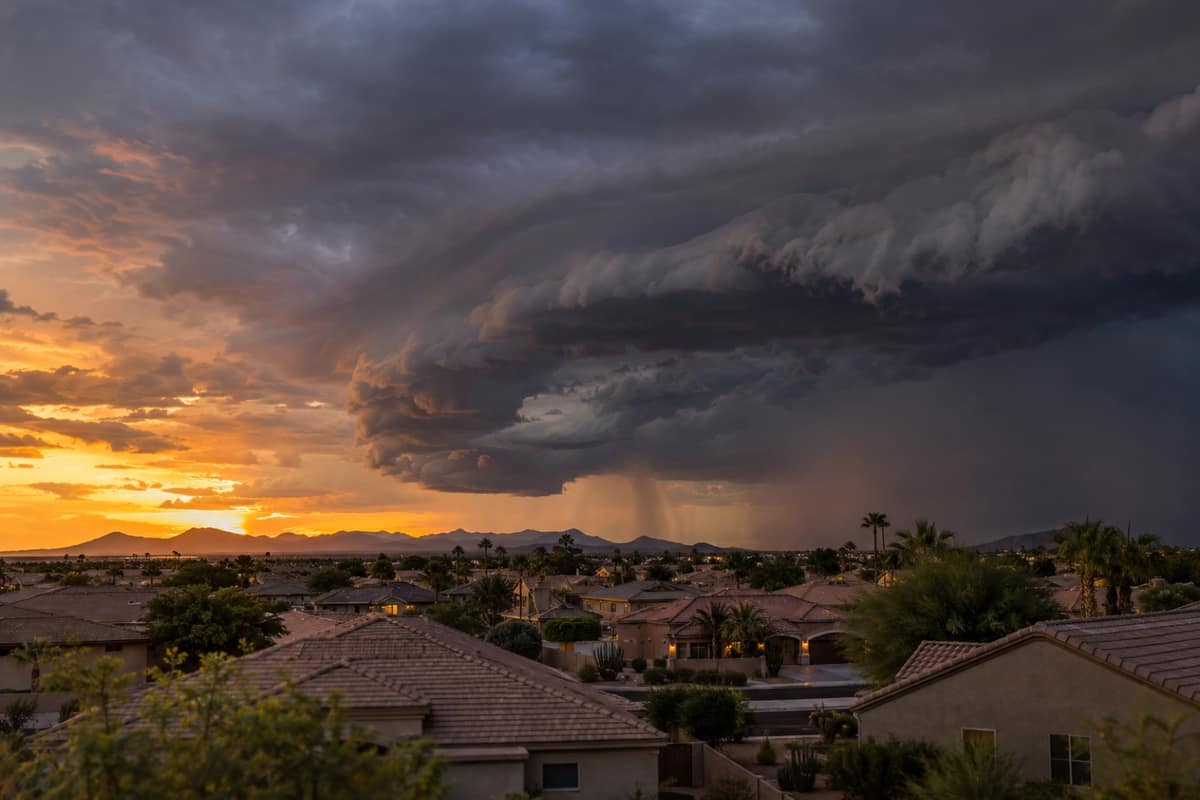
How Arizona home insurance treats monsoon damage depends on the cause: wind, hail and lightning are treated one way, and flood another. The Insurance Information Institute (iii.org) lists windstorm, hail, fire and lightning among the perils in standard homeowners policy forms, and says those policies generally exclude flood, which needs a separate flood policy.
Whether a monsoon claim is paid, and how much, depends on what caused the damage and on your policy’s terms, limits, exclusions and deductible, which you can find on your declarations page and in your policy form.
Key takeaways
- The Insurance Information Institute lists windstorm, hail, fire and lightning among the perils in every common homeowners policy form it compares.
- FloodSmart.gov, the National Flood Insurance Program’s site, says most homeowners and renters insurance does not cover flood damage.
- FloodSmart.gov says a new NFIP flood policy generally takes effect 30 days after purchase, so buy it at least 30 days before monsoon season.
- Check your dwelling limit and any wind or hail deductible before monsoon season.
- After a storm, document the damage, prevent further damage where it is safe, and report the claim promptly.
In this article
Which monsoon damage does a homeowners policy generally handle?
Wind, hail and lightning are the parts of a monsoon that standard homeowners policies are generally written for, according to the Insurance Information Institute. Its comparison of common policy forms, from basic to special, lists windstorm or hail and fire or lightning in every one of them.
In a monsoon, that can mean roof tiles or siding torn off by wind, a window broken by hail, or a fire started by lightning. Whether a claim for that damage is paid, and how much, depends on your policy’s terms, limits and exclusions, your deductible and the cause the adjuster finds. The Insurance Information Institute also notes that policies do not cover damage from lack of maintenance.
What about a tree that falls on the house?
The Insurance Information Institute says standard homeowners policies are generally written to respond when a tree felled by wind, lightning or hail hits the home or another insured structure, such as a detached garage, and when it damages the contents inside. Whether your claim is paid depends on your policy’s terms, limits and exclusions. The institute adds that poor tree maintenance is not covered, and that when a fallen tree hits nothing insured, there is generally no coverage to remove it.

Why does flood damage need a separate policy?
Standard homeowners policies generally exclude flood, so flood damage needs its own policy. FloodSmart.gov, the National Flood Insurance Program’s official site, says most homeowners and renters insurance does not cover flood damage, and the Insurance Information Institute lists flood among the disasters excluded from standard homeowners and renters policies.
FloodSmart.gov defines a flood as an excess of water on land that is normally dry, and its flood risk page notes that anywhere it can rain, it can flood. The same page explains that dry, hot conditions harden soil so it cannot soak up water, which leaves drought areas prone to flooding after a heavy rain. FloodSmart.gov also reports that nearly one-third of NFIP claims over the past 10 years came from outside high-risk flood zones.
Who can buy NFIP flood insurance?
According to FloodSmart.gov, any homeowner in a community that participates in the NFIP is eligible, including people who own condos and townhouses, and renters can buy coverage for their belongings. FloodSmart.gov lists NFIP limits of up to $250,000 for a home’s building and up to $100,000 for its contents. If you own a condo, check whether your HOA’s master policy includes flood coverage for the building; the condo insurance page explains how a unit policy works alongside the master policy.
When does a new flood policy take effect?
A new NFIP flood policy generally takes effect 30 days after purchase, according to FloodSmart.gov. That waiting period is why flood coverage has to be arranged before monsoon season, not when a storm is already in the forecast. FloodSmart.gov lists four exceptions:
- Mortgage: no wait if you buy flood insurance while making, increasing, extending or renewing a mortgage.
- Renewal: no wait if you change your flood coverage while renewing your policy.
- New flood map: a one-day wait if your property is newly mapped into a high-risk flood zone and you buy within 12 months of the update.
- Wildfire: a one-day wait if a flood is caused or worsened by a wildfire on federal land and you buy within 60 days of the fire’s containment date.
What should you do before and after a monsoon storm?
Before a storm, make a record of your home and belongings; after one, document the damage, prevent further damage where it is safe, and report the claim promptly.
What should you do before monsoon season?
- Read your declarations page. Check your dwelling limit and your deductibles, and note any deductible that applies differently to wind or hail.
- Photograph your home and belongings. FloodSmart.gov recommends photos and videos of major household items and valuables, with serial numbers, stored with important documents in a safe, dry place.
- Look after trees and the roof. Trim dead limbs and fix loose roofing before the season, since the Insurance Information Institute says policies do not cover damage from lack of maintenance.
- Decide on flood coverage early. Because of the 30-day wait FloodSmart.gov describes, a flood policy bought mid-season may not start in time.
What should you do after storm damage?
- Stay safe first. Keep clear of downed power lines and damaged structures.
- Document everything. Take photos and video before cleanup, and note the make, model and serial number of damaged appliances and electronics, as FloodSmart.gov advises for flood claims.
- Prevent further damage. Where it is safe, cover openings, remove standing water and keep receipts for what you spend on emergency repairs. FloodSmart.gov says NFIP policies do not cover mold or mildew damage the owner could have avoided, so dry things out quickly.
- Report the claim promptly. FloodSmart.gov advises reporting a flood loss to your insurer as soon as possible; report wind and hail damage to your home insurer promptly too.
- Be careful with contractors and callers. FloodSmart.gov warns that scammers may pose as adjusters or government agents after a disaster, and suggests talking to your agent or adjuster before signing a repair contract.
Get a home insurance quote from KGB Insurance
Have your current declarations page handy, and our agents will quote the limits and deductibles you carry today, then walk through anything you’d change, in English or Spanish. Our home insurance page explains each coverage. Call (480) 545-8877, Mon–Fri 8 a.m.–6 p.m. or Sat 8 a.m.–noon, or request a home insurance quote online.
Frequently asked questions
How does home insurance handle hail damage to a roof?
The Insurance Information Institute lists hail among the perils in every common homeowners policy form it compares. Whether a claim for hail damage to your roof is paid, and how much, depends on your policy’s terms, limits and exclusions and your deductible. Damage from lack of maintenance is different: the institute says policies do not cover it.
Does homeowners insurance pay for flash flooding?
Generally not. FloodSmart.gov says most homeowners insurance does not cover flood damage, and the Insurance Information Institute lists flood as excluded from standard homeowners policies. Flood insurance is sold as a separate policy, such as one through the NFIP, and what it pays depends on that policy’s own terms and limits.
Can I buy flood insurance when a storm is in the forecast?
You can buy it, but FloodSmart.gov says a new NFIP policy generally takes effect 30 days after purchase. FloodSmart.gov’s exceptions include buying it while making, increasing, extending or renewing a mortgage. For a storm already in the forecast, a policy bought that day will generally not be in force yet.
Do I need flood insurance outside a high-risk flood zone?
FloodSmart.gov reports that nearly one-third of NFIP claims over the past 10 years came from outside high-risk zones, and says that anywhere it can rain, it can flood. It also says any homeowner in a participating NFIP community is eligible.
When should I get a home insurance quote in Arizona?
Before your current policy is up for renewal. That leaves time to go over your limits and deductibles without a rush, and to line up a new policy with no gap in coverage. If you are buying a home, tell us your closing date. Then start a home insurance quote or call (480) 545-8877.
More insurance tips
- Auto · Arizona lawArizona’s 25/50/15 minimum, explainedRead the guide
- RentersWhat renters insurance is built for, and what it leaves outRead the guide
- Auto · After a crashAfter a car accident in Arizona: what to share, photograph and reportRead the guide
Mon–Fri 8–6 · Sat 8–12
Ask about your own policy.
Have your declarations page handy and we’ll quote the limits and deductibles you carry today, then walk through anything you’d change. In English or español.
Get a home quote Call (480) 545-8877